DISCLAIMER (INFORMATIONAL PURPOSE ONLY)
This article is a conceptual exploration of organizational design frameworks. It does not describe real product functionality, does not evaluate any HR software platform, and should not be interpreted as professional, legal, or operational advice.
Introduction: From HR Systems to Organizational Intelligence
Most modern HR platforms, including systems like Personio, were originally designed to solve a specific problem: how to efficiently manage employee records, payroll, onboarding, and compliance within structured organizations.
These systems excel in environments where roles are stable, hierarchies are clear, and work is predictable.
However, today’s organizations increasingly operate in a different reality—one defined by constant change, distributed teams, and overlapping responsibilities.
This shift raises an important question:
What happens when HR systems are no longer enough to describe how work actually happens?
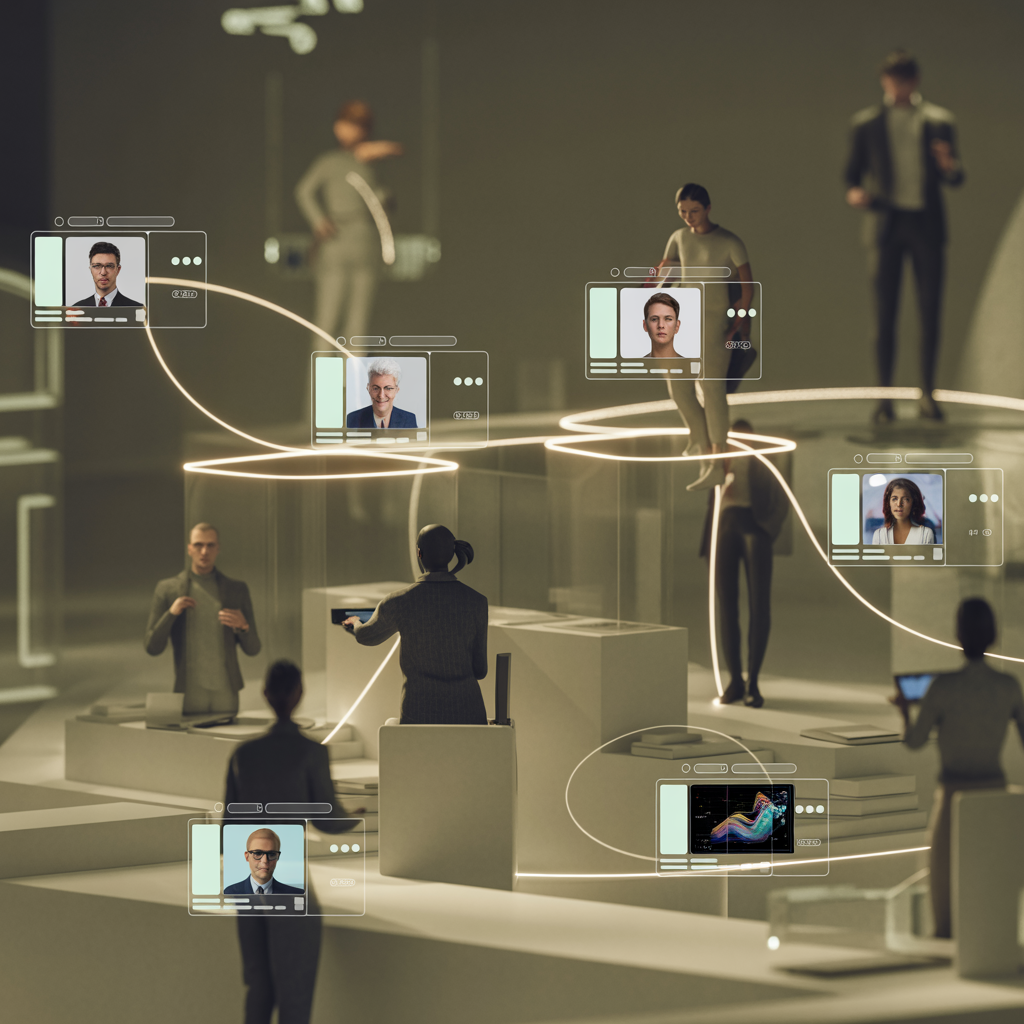
The People Flow Studio concept proposes an answer through skill-based organizational intelligence systems, where work is no longer tracked only as administrative data, but as a living network of skills, projects, and contributions.
Reinterpreting Personio in a Modern Organizational Context
In a traditional sense, Personio represents a structured HR backbone:
- Employee lifecycle management
- Payroll and compliance workflows
- Role definitions and contracts
- Administrative organizational structure
These functions remain essential for any company. However, they describe only the formal layer of an organization, not the operational reality of how work is executed day-to-day.
People Flow Studio introduces a conceptual separation:
- Administrative Layer (Personio-like systems) → defines structure
- Operational Intelligence Layer → defines actual work movement
This separation allows organizations to maintain stability while still adapting dynamically to change.
What Is Skill-Based Organizational Intelligence?
Skill-based organizational intelligence refers to a system that understands an organization not as a hierarchy of job titles, but as a continuously evolving map of skills and contributions.
Instead of tracking only employment status or department affiliation, the system analyzes:
- How skills are applied across projects
- How individuals collaborate in different contexts
- How performance changes depending on environment
- How capabilities evolve over time
In this model, people are not static roles—they are dynamic skill profiles in motion.
How Personio-Type Systems Differ From Organizational Intelligence Layers
Traditional HR platforms like Personio focus on:
- Static employee records
- Organizational charts
- Contractual and legal structure
- Standardized workflows
In contrast, skill-based intelligence systems focus on:
- Real-time skill usage
- Project-based contribution patterns
- Cross-functional collaboration flows
- Adaptive team formation logic
The difference is not about replacing HR systems, but about expanding the view of what an organization actually is.
The People Flow Studio Model of Organizational Intelligence
Within People Flow Studio, organizational intelligence is built on three interconnected layers:
1. Identity Layer (HR System — Personio-like)
Defines:
- Who the person is legally and structurally
- Employment status and formal role
- Compliance and administrative data
2. Skill Layer (Capability Mapping System)
Defines:
- What the person can do
- How skills interact across contexts
- How abilities evolve over time
3. Flow Layer (Dynamic Allocation System)
Defines:
- Where the person is currently contributing
- How work is distributed in real time
- How teams continuously reconfigure
Together, these layers create a multi-dimensional organizational model.
Why Static HR Models Are Not Enough
Even well-structured HR systems struggle with modern realities:
- Employees contribute across multiple teams simultaneously
- Roles change faster than HR records are updated
- Projects require temporary, cross-functional collaboration
- Work distribution is no longer linear or predictable
This creates a gap between:
- What HR systems show
- And what is actually happening inside the organization
People Flow Studio addresses this gap by introducing real-time organizational awareness.
Example: Skill Intelligence in Action
Consider a company using a hybrid structure:
- HR system (Personio-like) stores official roles:
- Designer
- Developer
- Product Manager
But in reality, project execution is more fluid:
- A designer contributes to UX, marketing visuals, and product strategy
- A developer works on frontend, internal tools, and performance optimization
- A product manager shifts between planning, research, and analytics
A skill-based intelligence system captures this reality, showing:
- Cross-functional participation patterns
- Skill growth trajectories
- Collaboration networks
- Real-time workload distribution
This creates a far more accurate picture of how the organization actually functions.
Benefits of Skill-Based Organizational Intelligence
1. Accurate Representation of Work Reality
Organizations gain visibility into actual contribution flows.
2. Improved Decision-Making
Resource allocation becomes data-driven rather than assumption-based.
3. Better Talent Development Insight
Skill evolution is tracked continuously, not just during reviews.
4. Enhanced Organizational Flexibility
Teams can be formed based on real capability networks, not static roles.
Risks and Structural Limitations
Despite its advantages, this model introduces complexity:
- Requires advanced data integration across systems
- Can create over-reliance on measurement frameworks
- Risk of misinterpreting qualitative work through quantitative signals
- Potential misalignment between HR records and operational reality
The challenge is ensuring that intelligence systems support human work without reducing it to overly simplified metrics.
The Future: From HR Systems to Living Organizations
The evolution suggested by People Flow Studio is not the replacement of systems like Personio, but their transformation into part of a larger ecosystem.
In the future, organizations may operate as:
- Stable administrative cores (HR systems)
- Adaptive intelligence layers (skill + flow systems)
- Continuous feedback networks (performance + collaboration data)
This would allow organizations to behave less like static structures and more like adaptive living systems.
DISCLAIMER (END NOTE)
This article is a conceptual exploration of organizational intelligence frameworks and does not represent real product capabilities, endorsements, or implementations.